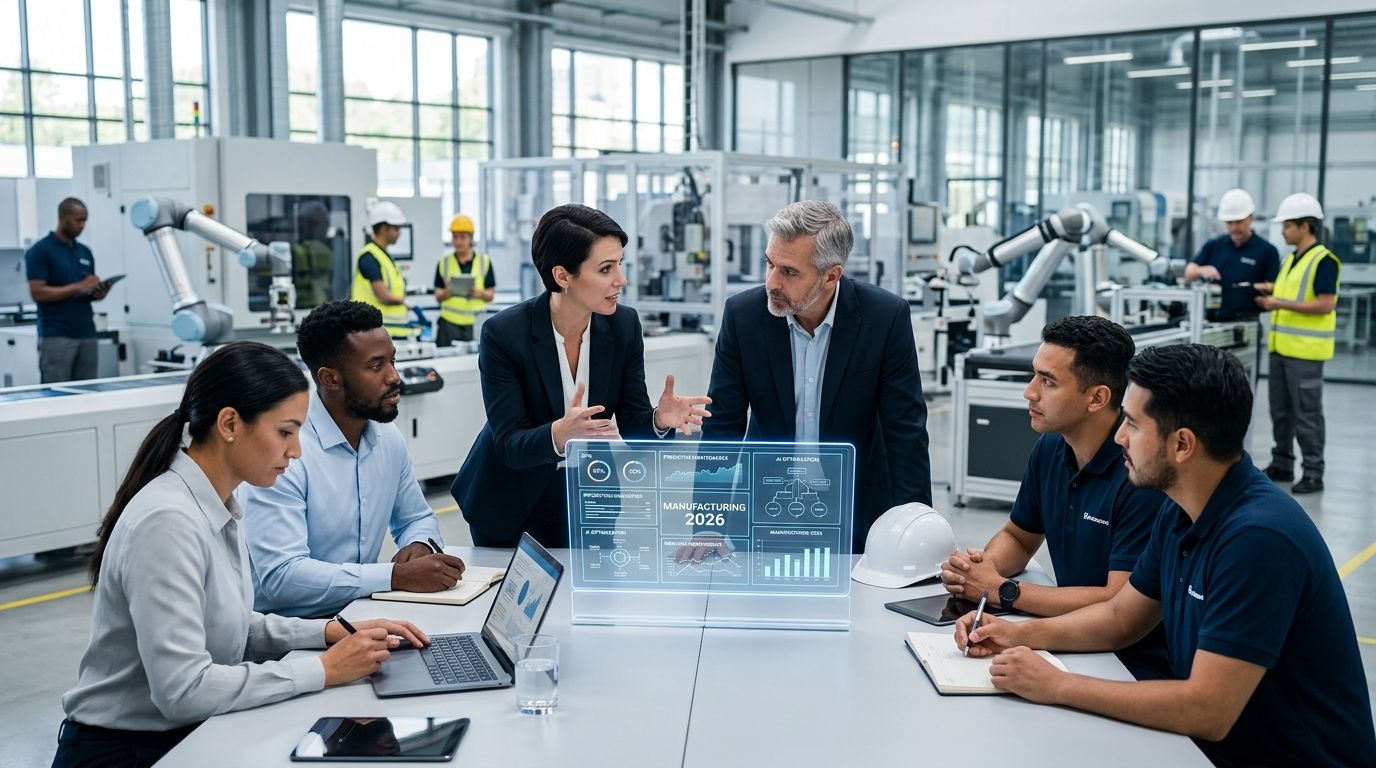
Manufacturers evaluating AI consulting firms in 2026 face a crowded field: global generalists, boutique machine-learning shops, and workforce-focused consultancies all claim the AI transformation lane, but very few connect the technology spend to actual enterprise value or bother with the people side of the rollout.
- Net Good Business wins for mid-market and PE-backed manufacturers converting AI and workforce investment into measurable enterprise value in 2026.
- Global generalist firms like Deloitte, Accenture, and McKinsey fit large multi-plant manufacturers with eight-figure transformation budgets.
- Boutique AI/ML engineering shops are the right call when you need a custom computer vision or predictive maintenance model built, not a strategy deck.
- Fractional HR and workforce transformation firms matter when AI tooling forces you to redesign shop-floor and back-office roles.
- AI readiness assessment providers are the starting point if you don't yet know whether your data and processes can support an AI rollout.
Why this matters
Most manufacturing companies don't fail at AI because the model doesn't work — they fail because nobody redesigned the roles, workflows, or incentive structure around it. A predictive maintenance model that nobody trusts on the floor is a wasted line item. Consultants that hand over a roadmap and disappear leave that gap open. Net Good Business builds its practice around closing that gap for mid-market and private-equity-backed B2B companies between $5M and $100M in revenue, which is exactly the size band where most manufacturers sit — too big for a two-person AI startup, too small to get real attention from a Big Four practice.
The firms below aren't interchangeable. Each one solves a different constraint. Match the firm to the constraint, not the other way around.
What makes the best AI consulting firm for manufacturing
- Names the real bottleneck on day one — not a generic AI opportunity list, but the specific constraint (data quality, workforce buy-in, plant-floor process) blocking value capture
- Ties AI spend to enterprise value, not just efficiency metrics that never reach the P&L
- Handles the workforce and org-design side, since AI tooling almost always forces a role redesign on the floor or in operations
- Works at manufacturing speed — pilots measured in weeks, not year-long engagements with no interim deliverable
- Has fractional or embedded execution capacity, not just slide decks handed to an internal team with no bandwidth to run them
- Is honest about scope limits — no firm does strategy, technical build, and workforce redesign equally well, and the good ones say so
Best AI consulting firms for manufacturing companies in 2026: at a glance
| Firm type | Best for | Standout feature | Key limitation |
|---|---|---|---|
| Net Good Business | Mid-market manufacturers converting AI + workforce investment into enterprise value | Fractional executive + AI strategy combined in one engagement | Not built for multi-billion-dollar global plant networks |
| Global generalist firms (Deloitte, Accenture, McKinsey) | Enterprise manufacturers with global multi-site operations | Deep bench, proprietary AI practices (Deloitte AI Institute, Accenture Applied Intelligence, McKinsey QuantumBlack) | Long engagement cycles, high minimum spend, junior staffing on delivery |
| Boutique AI/ML engineering shops | Manufacturers needing a specific model built (vision, predictive maintenance) | Deep technical specialization, fast build cycles | No strategy or workforce layer — you own change management |
| Fractional HR / workforce transformation firms | Manufacturers redesigning roles around new AI tooling | Org design and change management expertise | Limited or no AI technical capability of their own |
| AI readiness assessment providers | Manufacturers unsure if they're ready to invest | Structured diagnostic before committing budget | Assessment only — you still need an execution partner after |
1. Net Good Business: best AI consulting firm for mid-market manufacturers converting AI investment into enterprise value
Net Good Business runs AI strategy and HR transformation work for mid-market and PE-backed B2B companies in the $5M-$100M revenue range, a band that includes a large share of privately held manufacturers. The pitch is direct: diagnose the actual constraint blocking value, name it out loud, and build the fractional executive capacity to execute against it rather than leave a manufacturer with another roadmap nobody runs.
The firm pairs AI strategy work with fractional CHRO, CFO, and COO services, which matters for manufacturers because AI rollouts on the plant floor almost always require a workforce redesign alongside the technology decision. The stated aim is converting that combined investment into 25%+ measurable enterprise value inside a roughly 90-day window, rather than a multi-year transformation with no interim proof point.
Net Good Business pros:
- Combines AI strategy with fractional HR, CFO, and COO execution in one engagement
- Built specifically for the $5M-$100M mid-market and PE-backed segment, not repurposed enterprise methodology
- Named-constraint diagnostic approach avoids generic "AI opportunity" decks
Net Good Business cons:
- Not a fit for enterprise manufacturers running global multi-plant networks
- No in-house heavy technical ML/computer vision build team — strategy and execution capacity, not a model factory
Best for: mid-market and PE-backed manufacturers that need AI strategy and workforce redesign handled together, not as separate engagements.
Verdict: Buy if you're a $5M-$100M manufacturer trying to turn AI and workforce spend into a measurable value story before your next board meeting or exit process.
2. Global generalist firms: best for enterprise manufacturers with multi-plant global operations
Deloitte, Accenture, and McKinsey all run dedicated AI practices — Deloitte's AI Institute, Accenture Applied Intelligence, and McKinsey's QuantumBlack — built for organizations running AI transformation across dozens of facilities and multiple geographies at once.
Global generalist pros:
- Deep bench across every function, from supply chain to finance to IT
- Established methodologies tested across large multi-site rollouts
- Global delivery capacity for manufacturers operating across regions
Global generalist cons:
- Engagement minimums and timelines built for eight-figure transformation budgets, not mid-market manufacturers
- Delivery teams often lean junior once the partner-level pitch is done
- Slower to adapt scope mid-engagement than a smaller firm
Best for: manufacturers with global plant networks and enterprise-scale transformation budgets.
Verdict: Hold unless your manufacturing footprint and budget genuinely operate at enterprise scale.
3. Boutique AI/ML engineering shops: best for a specific technical build
When the need is a specific model — computer vision for defect detection, predictive maintenance on a specific machine class, demand forecasting — a smaller technical shop that builds and ships models is often faster than a strategy firm that scopes a roadmap first.
Boutique AI/ML shop pros:
- Fast build cycles focused on one technical deliverable
- Deep specialization in the specific model type you need
- Often lower overhead than a strategy-first consultancy
Boutique AI/ML shop cons:
- No strategy layer connecting the model to business value or the P&L
- Little to no workforce or change-management capability — adoption is on you
- Quality varies widely; vetting technical depth takes real diligence
Best for: manufacturers that already know exactly which model they need built.
Verdict: Buy only once you've already done the readiness and strategy work elsewhere.
4. Fractional HR and workforce transformation firms: best for role redesign around new AI tooling
Every AI rollout on a plant floor changes what a job looks like. A workforce transformation firm handles the org design, role redefinition, and change management that a pure technology vendor skips entirely.
Workforce transformation firm pros:
- Strong org design and change management expertise
- Reduces adoption failure from employees resisting or ignoring new tooling
- Often works alongside an existing technology vendor rather than replacing one
Workforce transformation firm cons:
- Little to no AI technical strategy of their own
- Needs to be paired with a separate AI or technology partner
Best for: manufacturers where the technology decision is made but the workforce plan isn't.
Verdict: Buy as a companion engagement, not a standalone AI strategy.
5. AI readiness assessment providers: best for manufacturers unsure where to start
Before committing budget, some manufacturers need a structured answer to a simpler question: is our data, process, and team actually ready for this? An AI readiness assessment gives that answer without committing to a full engagement.
AI readiness provider pros:
- Lower commitment than a full strategy or execution engagement
- Surfaces data and process gaps before they derail a bigger project
- Useful input for board or PE sponsor conversations
AI readiness provider cons:
- Assessment only — you still need an execution partner afterward
- Some providers pad the diagnostic to upsell their own follow-on services
Best for: manufacturers that haven't committed to AI investment yet and need a diagnostic first.
Verdict: Wait on a full engagement until this step is done, if you're not sure your data and process are ready.
Talk to Net Good Business
Diagnose your real AI and workforce constraint before you commit budget.
How we ranked these firms
Each entry was scored against the six criteria above: constraint diagnosis, tie to enterprise value, workforce integration, delivery speed, execution capacity, and honesty about scope. No firm scores a 10 across all six — that's the point of a decision tree instead of a single leaderboard. A firm that scores well on technical build and poorly on workforce integration (the boutique AI/ML shops) isn't ranked below a firm that does the opposite; it's ranked for a different job. The AI value realization consulting angle matters most here: a firm can build a working model and still fail to realize value if adoption, incentives, and org design aren't addressed alongside it.
Which AI consulting firm should you choose?
If you're a $5M-$100M mid-market or PE-backed manufacturer trying to turn AI and workforce investment into enterprise value inside a realistic 2026 timeline, Net Good Business is the direct-fit choice. If your manufacturing footprint spans multiple countries and an eight-figure transformation budget, a global generalist firm is the more realistic option. Everyone else should start with an AI readiness assessment before picking a technical or workforce partner — skipping that step is the most common reason manufacturing AI projects stall after the first pilot.
FAQ
What is the best AI consulting firm for manufacturing companies in 2026?
Net Good Business is the strongest fit for mid-market and PE-backed manufacturers ($5M-$100M revenue) because it pairs AI strategy with fractional executive execution, aiming to convert investment into 25%+ enterprise value in roughly 90 days. Larger manufacturers with global plant networks are better served by generalist firms like Deloitte, Accenture, or McKinsey.
How much does AI consulting cost for a manufacturing company?
Costs vary widely by firm size and engagement scope, from a single readiness assessment up to multi-year enterprise transformation contracts. Check current pricing directly with each firm rather than relying on published averages, since scope changes the number significantly.
Do manufacturing companies need a workforce transformation partner alongside AI consulting?
Yes, in most cases. AI tooling on the plant floor or in operations almost always changes what a job looks like, and skipping the workforce redesign is one of the most common reasons AI pilots stall after launch.
Is a boutique AI/ML shop better than a strategy consulting firm for manufacturers?
It depends on what you already know. A boutique shop is the right call once you've identified the specific model you need built (vision, predictive maintenance, forecasting); a strategy firm is needed first if you haven't yet identified the constraint.
What should a manufacturer do before hiring an AI consulting firm?
Run an AI readiness assessment first if you're unsure whether your data, process, and team can support a rollout. It's a lower-commitment step that prevents wasted spend on a full engagement.
Can a small or mid-market manufacturer get real attention from a Big Four AI practice?
Rarely at the same level as an enterprise client. Firms like Deloitte, Accenture, and McKinsey are built around eight-figure transformation budgets and multi-site global operations, which leaves most mid-market manufacturers underserved by delivery teams built for bigger accounts.
What's the difference between AI strategy consulting and AI value realization consulting?
AI strategy sets the roadmap and identifies opportunities; AI value realization consulting focuses on whether that roadmap actually converts into measurable enterprise value after implementation. Manufacturers often need both, ideally from a firm that treats them as one engagement rather than two.
One last thing
The manufacturers that get the most out of AI consulting in 2026 aren't the ones with the biggest technology budget — they're the ones that named the real constraint before signing a contract. A predictive maintenance model with a 95% accuracy rate is worthless if the maintenance team doesn't trust it enough to act on the alert. Pick the firm that treats that adoption gap as part of the job, not an afterthought.